Tag: urban governance

  • Inside the Revenue Mix: What Makes Up a City’s Own Source Revenue? 

    Inside the Revenue Mix: What Makes Up a City’s Own Source Revenue? 

    A city’s fiscal autonomy is only as strong as the revenue it generates on its own and, as our last blog post showed, that autonomy is far from evenly distributed. But what exactly makes up that revenue?

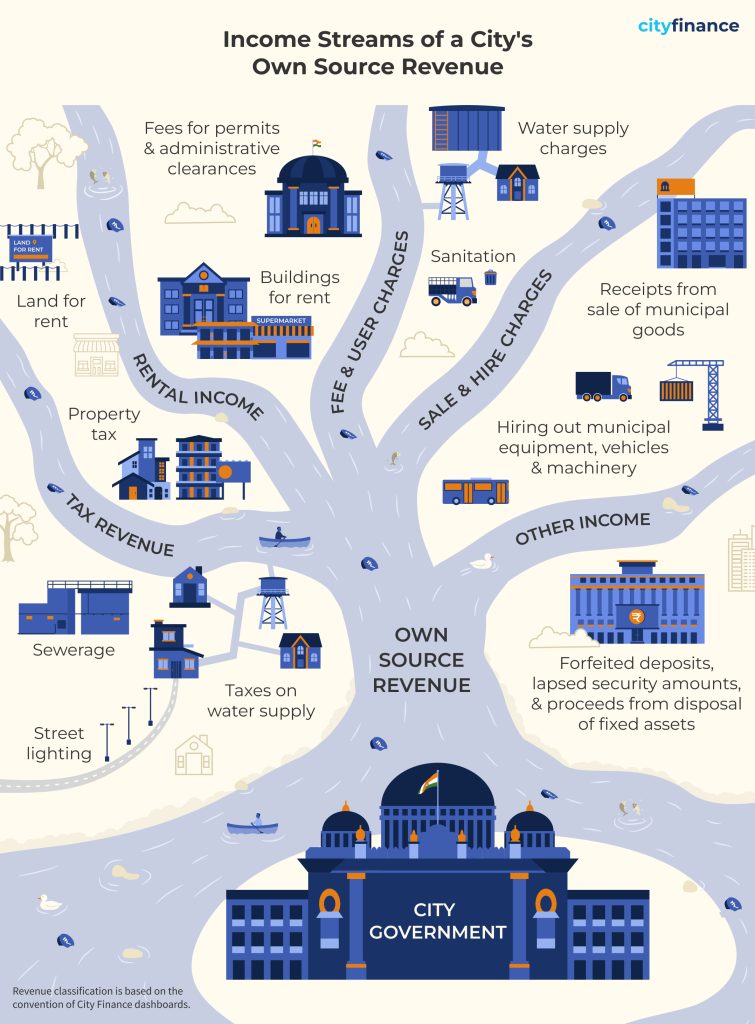
    In our previous blog post, we explored how Own Source Revenue (OSR) is generated across cities of different sizes and states. OSR is not a single revenue stream; it is a combination of different revenue components that Urban Local Governments (ULGs) generate through their taxation powers, service delivery functions and assets. Each of these components contributes differently, shaping the overall structure of municipal own revenue.

    At its core, OSR comprises two broad categories: tax and non-tax revenue. Tax revenue is dominated by property tax, alongside levies on water supply, sewerage, conservancy, street lighting, education, and other municipal services. 

    Non-tax revenue is more diverse and includes fees and user charges for services such as water supply, sanitation, and solid waste management, as well as payments for licenses, permits, and regulatory approvals. Other important components include sale and hire charges, generated from the sale of municipal goods and the hiring of municipal equipment or vehicles, and rental income from leasing municipal assets such as shops, markets, community halls, and land. 

    OSR also includes a residual category termed ‘other income,’ comprising receipts such as forfeited deposits, employee recoveries, disposal of assets, and various accounting adjustments. Unlike taxes and user charges, these receipts are often irregular and unpredictable. 

    The average composition of Own Source Revenue of Indian ULGs across FY 2019–20 to FY 2021–22 highlights the continued dominance of tax revenue, which accounts for half of total OSR. Fees and user charges constitute the second-largest component at 32 per cent, underscoring the importance of service-linked non-tax revenues in municipal finances. Other income contributes 14 per cent, while rental income (3 per cent) and sale and hire charges (1 per cent) together form a relatively small share. Overall, the revenue mix suggests that municipal finances remain anchored in taxation, with non-tax sources, particularly fees and user charges, playing an important, complementary role in strengthening local revenue generation. 

    From Small Towns to Megacities: A Telling Revenue Picture

    FY 2021–22 data shows that tax revenue remains the primary source of OSR for most Indian cities. The notable exception is 4-million-plus cities (4M+ cities), where fees and user charges account for the largest share (47 per cent). 4M+ cities and cities with population less than 100K show a relatively higher share of ’other income’. In contrast, sale and hire charges remain marginal across all city categories. 

    ULGs of a majority of Indian states exhibit limited diversification in their OSR structures, with heavy reliance on tax revenue and fees and user charges. In 12 out of 24 states analysed, these two sources together account for more than 75 per cent of total OSR. Rental income remains a minor contributor in most states, averaging around 15 per cent across the sample. Sale and hire charges are negligible almost universally, rarely exceeding 10 per cent. 

     Key Takeaways 

    The composition of a city’s Own Source Revenue tells a story not just of how much OSR it raises, but of how it raises it and how sustainably it can do so. Across Indian states, the picture is one of limited diversification, a heavy reliance on tax revenue and fees and user charges, with rental income and other receipts remaining largely untapped.  

    Improving Own Source Revenue is not just about diversifying revenue streams. It demands strengthening collection efficiency within existing sources, rationalising fee structures, and reducing dependence on a narrow own revenue base. Achieving this, however, demands skills and capacities that many ULGs, particularly smaller ones, currently lack. Hence, strengthening local capacity is an equally important priority.  As cities face growing expenditure pressures, building a more resilient and self-sufficient municipal finance system is not just a fiscal imperative, it is foundational to delivering better urban services and stronger local governance. 

    Stay tuned for a closer look at the key components of Own Source Revenue of cities.  

    Note: All data is sourced from the Annual Financial Statements submitted by the ULGs on the CityFinance platform. To ensure comprehensive representation and account for variations in data coverage and quality across cities, the figures presented are based on extrapolated financial data covering all 4,824 cities. Among these, 2,541 cities (approximately 60%) possess 3 years of contiguous data (2019–20 to 2021–22) in Cityfinance platform. Data from these cities have been systematically extrapolated using the ’per capita scaling methodology’ to reflect the financial performance of the complete set of 4,824 cities. Learn more about the extrapolation methodology here.  

  • Exploring the Fiscal Autonomy of Cities with CityFinance.in: A Beginner’s Guide

    Exploring the Fiscal Autonomy of Cities with CityFinance.in: A Beginner’s Guide

    This Fiscal Autonomy Primer marks the third edition in a multi-part series on the financial data of cities hosted on CityFinance.in. Each edition in the series will spotlight one key fiscal indicator, offering a focused analysis to demonstrate the different kinds of insights that can be drawn from the data and how they inform a deeper understanding of urban finance. This initiative aims to foster greater understanding and engagement with the financial data of Indian cities, with the broader goal of enabling deeper analysis and further research in this critical area. In this edition, we will be looking at a crucial parameter that determines a city’s financial stability: Own Source Revenue.

    What if India’s cities could only spend what they earned? For most Urban Local Governments (ULGs), this would mean dramatic cuts to essential services, revealing a dependence on state and central transfers rather than self-generated revenue. A deeper examination of the Own Source Revenue (OSR) patterns of cities is therefore crucial to enhance urban financial sustainability across India.

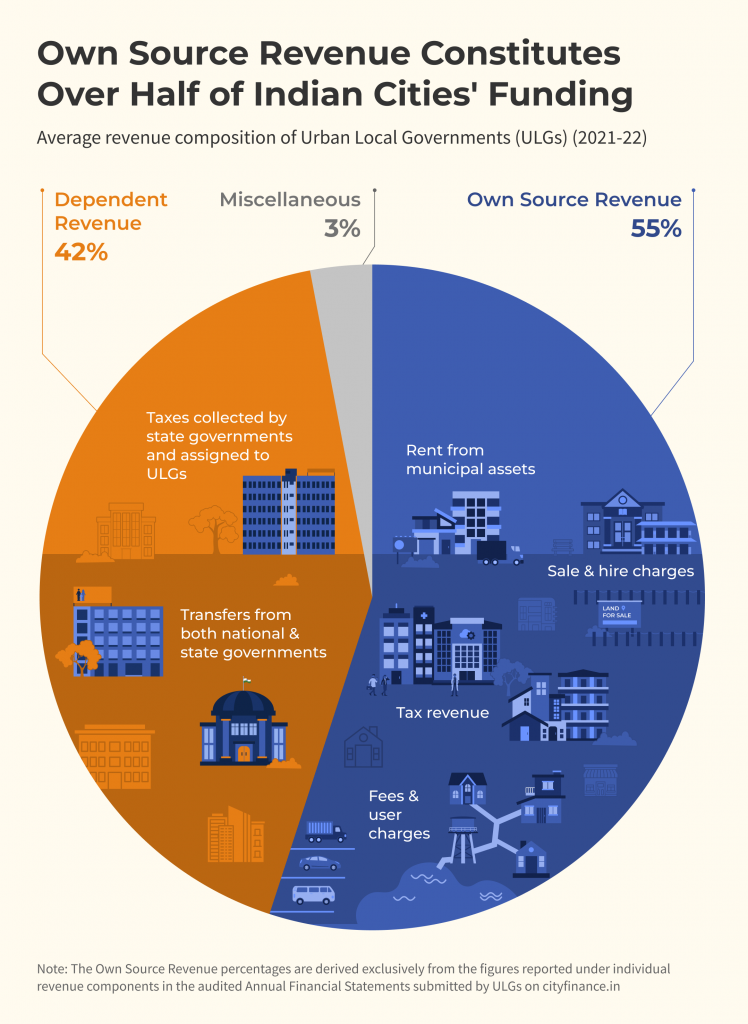
    Own Source Revenue refers to the income that ULGs generate independently through their own taxation powers, service and other charges. It comprises tax revenue, revenue from fees and user charges, sale and hire charges, rental income from municipal properties, and other sources of income that is not coming from central or state governments.

    The data reveals that Own Source Revenue contributed around half of aggregate total revenue of ULGs in FY 2021-22. While this trend appears encouraging at the aggregate level, a closer look at OSR composition across cities of varying sizes is warranted. 

    A clear pattern emerges: larger cities consistently outperform smaller ones in generating their own revenue.

    Geography of Fiscal Self-Reliance 

    The geographic variation in OSR performance across cities of different sizes and states suggests that outcomes are shaped by a confluence of factors, including levels of urbanisation, economic base, state-level fiscal frameworks, and administrative capacity. However, strong OSR figures must be interrogated further: the critical question is whether these own revenue gains are resulting in measurably better services for urban residents.

    Beyond Taxes, Fees and User Charges: Improving Fiscal Autonomy

    Improving fiscal autonomy requires more than just strengthening tax collection and rationalising fees and user charges. ULGs can meaningfully expand their fiscal autonomy through municipal bonds and public-private partnerships. 

    A municipal bond is a marketable debt instrument where a ULG borrows funds from investors for a defined period at a fixed or variable interest rate. The funds raised can be used for infrastructure development. This allows ULGs to access money immediately while paying it back through future revenues, helping them attract long-term capital, build credit profiles, and bring greater accountability and transparency to citizens.  

    However, municipal bonds remain severely underutilised – only 22 ULGs have issued bonds since the Securities and Exchange Board of India (SEBI) released its guidelines in 2015. The promise of municipal bonds can only be realised if ULGs are genuinely equipped to use them. This calls for enhanced fiscal discipline, robust financial processes, stronger institutional capacity at the local level, and more structured engagement with private partners through Public-Private Partnerships (PPPs). Without these enabling conditions, municipal bonds will remain an instrument available on paper but out of reach in practice for the vast majority of India’s cities.

    Bridging the Gap: The Road Ahead

    The OSR patterns and the extent of use of instruments like municipal bonds collectively point to an urban fiscal landscape where the capacity for self-finance is heavily skewed toward larger cities with better capacities, leaving smaller ULGs disproportionately dependent on grants and transfers. Bridging this gap will require targeted interventions, modernising tax systems, rationalising fees and user charges, and building administrative capacity in smaller cities. Without deliberate and sustained reforms to strengthen municipal revenue systems at the grassroots, the promise of genuine urban financial autonomy will remain concentrated at the top, widening, rather than narrowing, the divide between India’s metro giants and its smaller cities.

    Stay tuned for a deeper look into Own Source Revenue of cities.

    Note: All data is sourced from the Annual Financial Statements submitted by the ULGs on the CityFinance platform. To ensure comprehensive representation and account for variations in data coverage and quality across cities, the figures presented are based on extrapolated financial data covering all 4,824 cities. Among these, 2,541 cities (approximately 60%) possess 3 years of contiguous data (2019–20 to 2021–22) in Cityfinance platform. Data from these cities have been systematically extrapolated using the ’per capita scaling methodology’ to reflect the financial performance of the complete set of 4,824 cities. Learn more about the extrapolation methodology here.

  • Unpacking Urban Revenue Composition 

    Unpacking Urban Revenue Composition 

    In our previous blog on total revenue of Indian cities, we explored how total revenues vary dramatically across Indian cities, with resources concentrated in major metropolitan areas. But these total revenue figures reveal only a part of the story.  

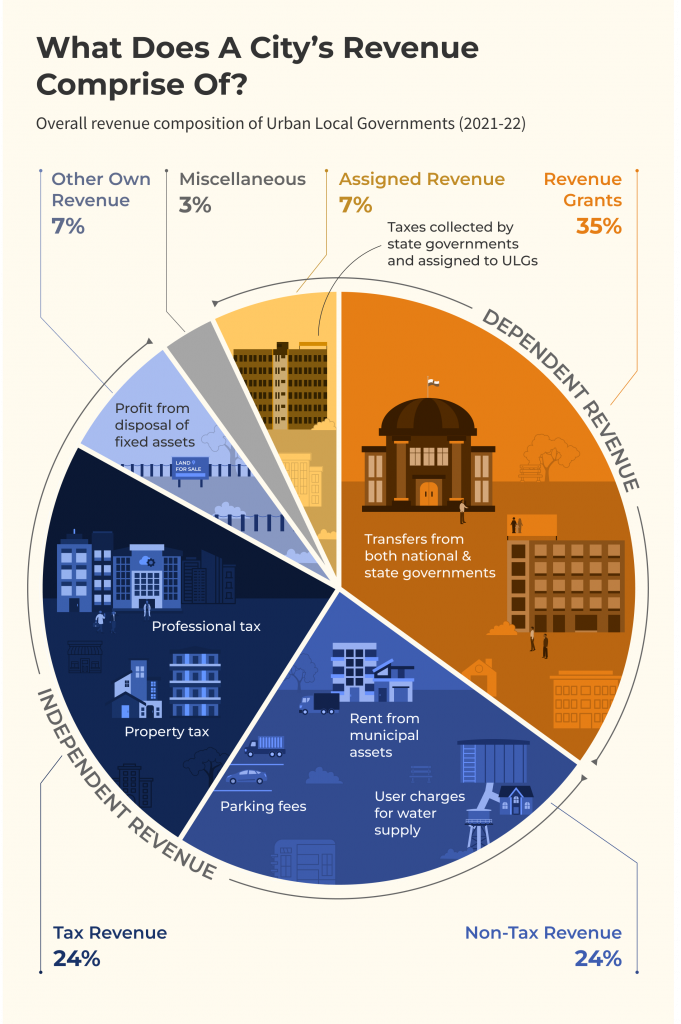
    Understanding where that revenue comes from is equally important. The composition of a city’s revenue, how much it raises on its own versus how much it receives from higher tiers of government, speaks directly to its fiscal autonomy, financial resilience, and capacity for self-determined growth. Examining revenue composition thus moves the conversation beyond how much cities earn to how they earn it.

    As shown in the figure above, at the national level, the composition of municipal revenues exhibits a substantial share of grant revenue across ULGs. However, when we look at the graph below, we can see that this share is comparatively lower for million-plus cities. CityFinance data shows that larger ULGs, particularly million-plus cities, demonstrate a stronger own-source revenue base, supported by both tax and non-tax revenues, relative to smaller cities. 

    Although million-plus cities receive significant volumes of grants, these constitute a smaller proportion of their total revenue when compared to smaller ULGs. This reflects the larger revenue base of metropolitan cities, where tax and non-tax revenues contribute a greater share to overall municipal finances. 

    Notably, 4M+ cities show a relatively higher share of non-tax revenue within their revenue. This indicates a more diversified revenue composition with contributions from user charges, fees, rentals, and other service-related income streams alongside tax revenue. In contrast, smaller ULGs exhibit a relatively higher dependence on revenue grants within their overall revenue structure. 

    Overall, the data highlights variation in revenue composition across city size categories, reflecting differences in revenue structure and scale across urban India. 

    When compared with the national profile, state-wise regional variation becomes much more evident for FY 2021-22. 

    Northern states such as Uttar Pradesh (80% grants), Uttarakhand (84%), and Bihar (67%) show grant shares well above the national aggregate composition, with relatively lower tax and non-tax contributions. In contrast, southern states display a different composition: Telangana records 48% tax revenue and Andhra Pradesh 42% tax revenue, while Tamil Nadu shows a more balanced mix with 29% tax revenue and 34% grants. Gujarat and Maharashtra also exhibit less dependence on grants when compared to national aggregate composition.  

    Overall, the comparison reflects regional differences in revenue structure relative to the national composition, highlighting variation across India’s urban fiscal landscape.

    The Way Forward

    The analysis underscores that revenue profile of cities in India cannot be understood through aggregate revenue figures alone. A deeper look at revenue composition reveals important distinctions. While the proportion of intergovernmental grants in revenue composition of smaller cities remains higher, larger cities continue to receive higher per capita grants. The findings suggest that million-plus cities show higher collection of own-source revenue. Assigned revenue on the other hand decreased consistently which is a trend that warrants closer examination. The variations across states further reinforce that fiscal outcomes are influenced by governance structures, devolution frameworks and accounting practices.  

    Moving beyond aggregate figures to examine how city revenues are composed will offer a far more comprehensive understanding of where Indian cities stand fiscally and what it will take to strengthen their financial foundations. 

    In our next blog, we turn to Own Source Revenue performance across city categories and states and what it reveals about the fiscal health of India’s urban local governments. Stay tuned. 

    Note: All data is sourced from the Annual Financial Statements submitted by the ULGs on the CityFinance platform. To ensure comprehensive representation and account for variations in data coverage and quality across cities, the figures presented are based on extrapolated financial data covering all 4,824 cities. Among these, 2,541 cities (approximately 60%) possess 3 years of contiguous data (2019–20 to 2021–22) in Cityfinance platform. Data from these cities have been systematically extrapolated using the ’per capita scaling methodology’ to reflect the financial performance of the complete set of 4,824 cities. Learn more about the extrapolation methodology here.

  • Exploring City Expenditures with CityFinance.in: A Beginner’s Guide 

    Exploring City Expenditures with CityFinance.in: A Beginner’s Guide 

    This Total Expenditure Primer marks the second edition in a multi-part series on the city financial data hosted on CityFinance.in. Each edition in the series will spotlight one key fiscal indicator, offering a focused analysis to demonstrate the different kinds of insights that can be drawn from the data and how they inform a deeper understanding of urban finance. This initiative aims to foster greater understanding and engagement with the financial data of Indian cities, with the broader goal of enabling deeper analysis and further research in this critical area. Here we will be dealing with a crucial parameter that determines a city’s financial stability: Total Expenditure.

    What is a City’s Total Expenditure?  

    Urban infrastructure and services, from street lighting and water supply to road maintenance, are tangible results of a city’s expenditure at work. Understanding how much cities spend, how these funds are allocated, and why significant variations exist across urban centres is essential to evaluating the state of India’s urban governance. 

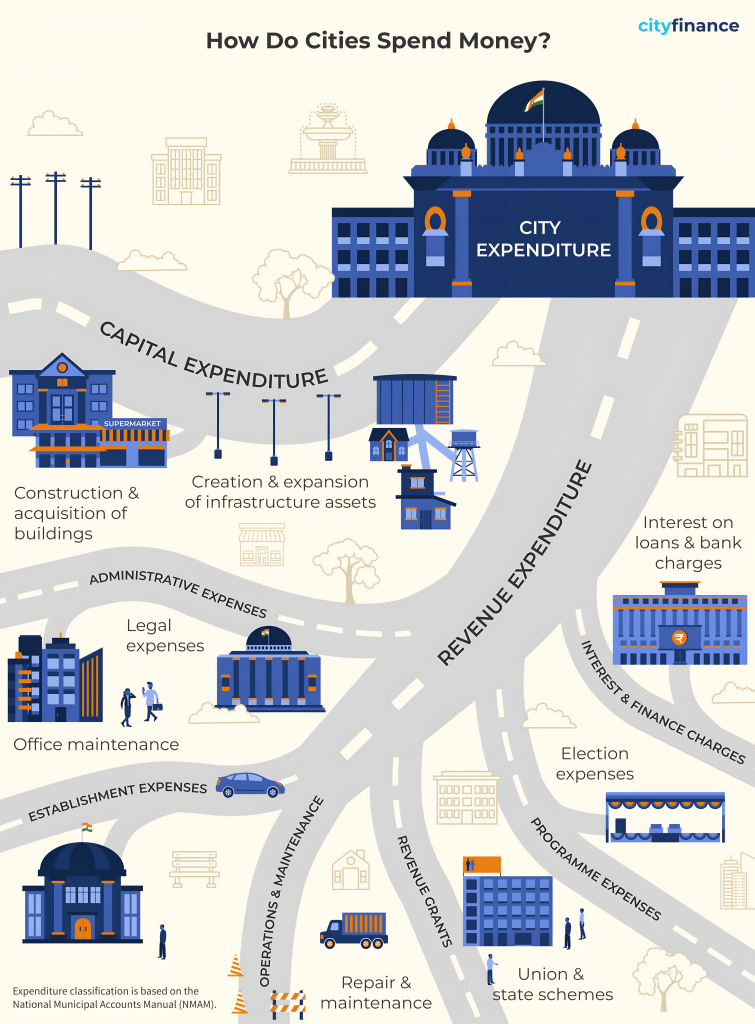
    At its simplest, Total Expenditure represents the complete amount of money spent by an Urban Local Government (ULG) during a financial year. It comprises two main components:  

    • Revenue Expenditure covers the day-to-day operational costs necessary to keep urban services running smoothly.  
    • Capital Expenditure refers to investments in creating or upgrading long-term infrastructure and assets.  

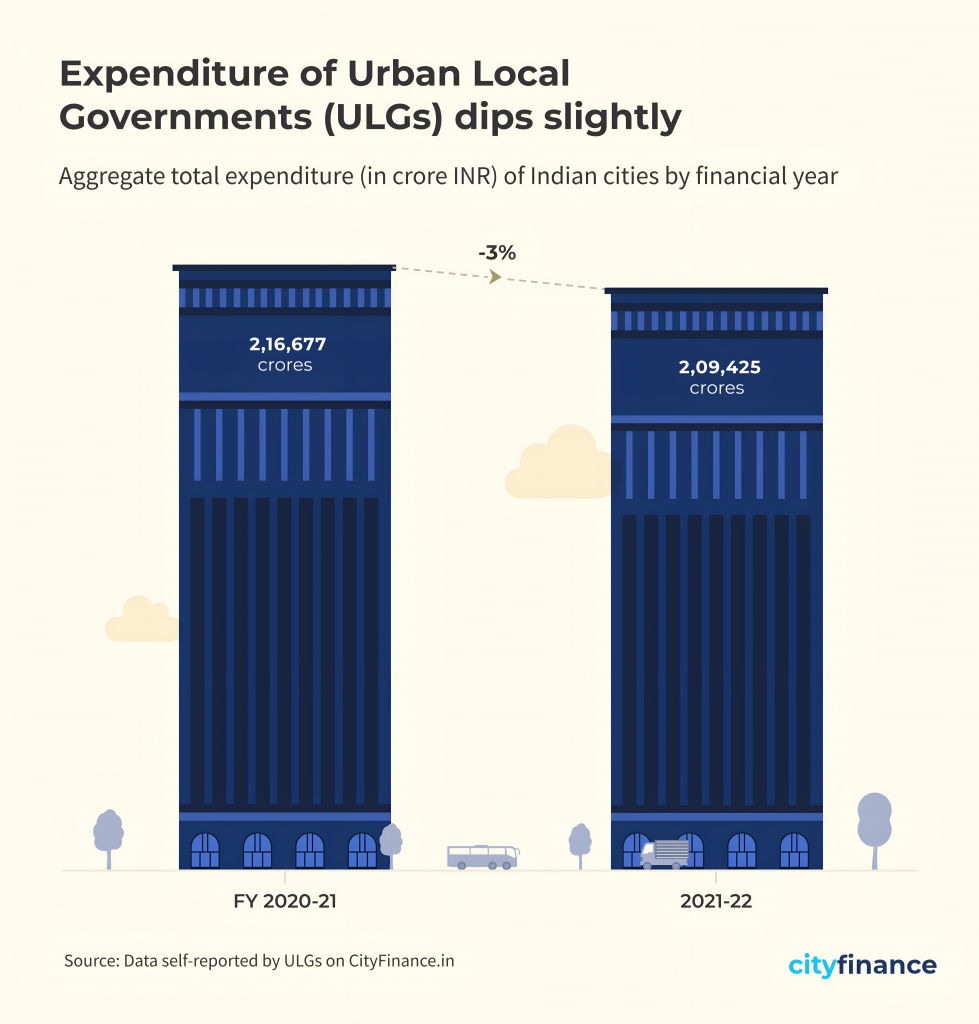
    ULG Expenditure Trends: A Decline in Spending (2020-2022) 

    Data shows that total expenditure of ULGs declined from 2020-21 to 2021-22. This drop in expenditure requires detailed investigation to determine whether it stems from reduced developmental or capital spending, lower recovery-related expenditure post-pandemic, contraction in government programmes, or a combination of these factors.  

    To understand this expenditure trend, let us examine how this change is  reflected in different population categories.  

    The Expenditure Divide: Unequal Fiscal Capacity across Cities

    Looking at the chart, it is clear that expenditure patterns vary significantly across different city categories. While it is expected that larger cities would spend more, the disparity is stark. Large cities with populations above 4 million account for the lion’s share of urban spending while smaller cities demonstrate modest expenditure levels.  

    It is important to note that these cities differ significantly in population size, revenue composition, urban service priorities, and other characteristics. Therefore, analysing expenditure patterns requires a differentiated approach that accounts for the distinct contexts of different city categories. 

    Examining per-capita spending reveals an interesting picture with megacities spending several times more per urban resident than mid-sized and smaller ULGs. This divergent fiscal behaviour suggests structural inequalities in urban finance. We must ask whether these differences stem from variations in resource availability, administrative capacity, or the differentiated cost of delivery of services in a metropolis versus a small town.  

    Across India: The Geography of Urban Spending 

    Expenditure capacity also varies by geography. As seen above, when we look at a state-by-state comparison, Southern and Western states demonstrate strong fiscal performance. Northern states show mixed performance, with some states maintaining surpluses while others exhibit low levels of expenditure. North-eastern states reveal an interesting picture with varied fiscal capacities across the region. 

    From Spending to Service Delivery: The Way Forward 

    While India’s megacities lead in urban spending, we cannot yet determine whether higher spending translates into better urban outcomes, as we lack the data linkages to connect expenditure with service delivery outcomes.  

    What matters is allocation. The allocation patterns between revenue and capital expenditure require further study to understand if cities that channel more funds towards water supply, sanitation, mobility, and public spaces, achieve better service quality compared to cities whose spending is dominated by administrative costs. It is important to note that establishment expenses could also reflect investments in hiring personnel to improve urban service delivery, which may contribute positively to service outcomes. However, strengthening local capacity for planning, budgeting, and monitoring is essential to ensure that every additional rupee spent enhances liveability and equity for urban residents.  

    As India prepares for 600 million urban residents by 2036, understanding these expenditure gaps is critical. As we saw in our previous blog on a city’s total revenue, it is clear that a city’s income streams directly dictate its capacity to spend. Hence, it is important to look at the different revenue streams of a ULG.  

    Stay tuned for a deep dive into a city’s own revenue. To explore more and see your city’s expenditure in detail, head over to cityfinance.in.

    Note: All data is sourced from the Annual Financial Statements submitted by the ULGs on the CityFinance platform. To ensure comprehensive representation and account for variations in data coverage and quality across cities, the figures presented are based on extrapolated financial data covering all 4,824 cities. Among these, 2,541 cities (approximately 60%) possess 3 years of contiguous data (2019–20 to 2021–22) in Cityfinance platform. Data from these cities have been systematically extrapolated using the ’per capita scaling methodology’ to reflect the financial performance of the complete set of 4,824 cities. Learn more about the extrapolation methodology here.


  • Data That Drives Change: Towards Standardisation of Municipal Finance Data 

    Data That Drives Change: Towards Standardisation of Municipal Finance Data 

    India is undergoing rapid urbanisation. An ever-growing urban population necessitates an increase in urban services and infrastructure. The quality and sustainability of this urban infrastructure and services hinge fundamentally on the sound management of municipal finances, as it enables cities to plan, fund, and maintain essential services adequately.  

    Post the 15th Finance Commission, the breakthrough that CityFinance platform has brought about in municipal finance data availability is transformative, creating new opportunities for transparency, accountability, and informed decision-making. Yet, as promising as this progress is, the journey would be far from complete without standardizing the available data.  

    Comparing financial data across cities becomes nearly impossible when one municipality measures revenue in one classification system while another uses an entirely different structure, much like trying to compare distances when one city reports in kilometres and another in miles, using different starting points and routes.  

    Standardizing municipal finance data is, therefore, the next crucial step to unlock its full potential. 

    From Fragmentation to Clarity: Unifying Municipal Financial Records 

    When municipal finance data was made publicly available on CityFinance.in, users encountered a vast but unwieldy pool of information. Data was technically accessible, yet functionally fragmented, locked behind inconsistent formats, conflicting definitions, and incompatible templates.   

    Significant variations remained in the reporting of municipal finance data. For example, in Tamil Nadu’s cities, data is submitted in three different formats across Municipal Corporations, Town Panchayats and Municipalities. In Odisha, cities such as Bhubaneswar, Hinjlicut, and Baripada each use varying codes and accounting structures. Similarly, cities in Punjab, across Municipal Corporations and Municipalities, do not fully adhere to the NMAM chart of accounts and codes. These variations hinder cross-city comparisons, benchmarking, and in-depth fiscal analysis, as differing terminologies, classifications, and accounting bases create opaque and inconsistent datasets.  

    Navigating Progress and Overcoming Hurdles in Municipal Data Alignment 

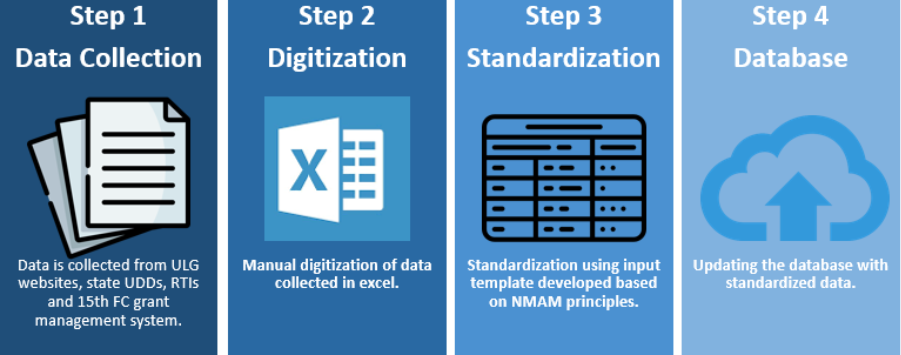
    Recognizing these barriers, the CityFinance platform has made significant strides toward harmonizing accounting formats and promoting the broader adoption of standardized reporting aligned with NMAM(National Municipal Accounting Manual).  

    CityFinance platform’s four-step process streamlines the journey from scattered city ledgers to a unified database, making reliable municipal financial analysis accessible to all stakeholders. Following this process, the data is organized into standardized files containing 77-line items grouped under four heads – income, expenditure, assets, and liabilities – in accordance with National Municipal Accounting Framework established by MoHUA.   

    Through this process, substantial progress has been made: Standardized financial data for at least one year is now available for 89% of India’s ULGs on the CityFinance platform. This standardized format enables multiple analytical lenses: state-wise comparisons, temporal studies, ULG-specific assessments, cross ULG comparisons, population category-based analyses, ULG type-wise evaluations and much more.  

    Looking at the graph above, over 86% of ULGs with populations above 1 million have four years of standardized data from 2019–2023. This focus on larger cities has been intentional—they handle higher volumes of revenue and expenditure and serve a substantial share of India’s urban population, making their data vital for scalable insights and policy design.  

    The above chart highlights multiple barriers to data standardization across ULGs. These errors underscore the need for stronger guidance and technical support to improve data submission standards. 

    The map below reveals that over 10 states have 90% of ULGs data standardized, others, such as Haryana, Meghalaya, and Sikkim, lag significantly behind.  

    The Power of Clean Data: Driving Smarter Urban Governance 

    Standardized municipal finance data is the cornerstone of effective governance. It equips policymakers with reliable fiscal information to design targeted policies, allocate resources effectively and benchmark performance across cities.  

    Standardized data empowers cities to assess their financial health, monitor compliance, and improve service delivery. It enables evidence-based planning, better budgeting, and performance benchmarking across peers.  

    For state and national government officials, standardized municipal finance data provides a reliable basis for monitoring fiscal performance, designing incentive frameworks, and targeting capacity-building efforts. It enables cross-ULG benchmarking, compliance tracking, and policy evaluation at scale.  

    For market participants i.e. credit rating agencies, investors, and financial institutions – standardized data enhances visibility into municipal creditworthiness, enabling risk assessment, debt structuring, and investment in instruments like municipal bonds with greater confidence. 

    Standardized municipal finance data offers researchers and civic organizations a consistent, comparable foundation to analyze urban fiscal trends, governance outcomes, and equity in resource allocation. Civil society groups can use this data to monitor public spending, engage constructively with local governments, and push for reforms grounded in evidence and public interest. 

    Breaking Barriers: Building a Resilient Municipal Finance Data Ecosystem 

    Standardized municipal finance data has begun to reshape urban fiscal governance, enabling smarter policy, better financial management, and more informed understanding.  

    However, this is just the beginning. The next frontier lies in tapping directly into ULG systems to automate data exchange and eliminate manual reporting and duplication. Integrating technologies like APIs and accessing centralized accounting systems can ensure seamless, timely, and accurate data flows. Alongside this, targeted capacity-building for municipal officials and stronger enforcement of reporting standards will be critical to sustaining data quality and expanding coverage. CityFinance is actively working to enable this shift. 

    To dive deep into the standardization process, see: How We Standardize Annual Financial Statements? Explore standardized municipal finance data on CityFinance and see how your city compares.  

  • Welcome to the CityFinance Blog!

    Cities shape our everyday lives and understanding how they’re funded, how they spend and how they plan for the future is important. Financial data of cities is often hard to find, harder to interpret and rarely presented in ways that invite public engagement and discourse. 

    cityfinance.in was created to change that. 

    As India’s national open platform for urban financial transparency, the CityFinance platform brings together key financial information from cities across the country. It helps users explore annual financial statements & budgets and compare financial performance – all in one place. Whether you’re a city official, a researcher, a journalist or simply curious about how cities work, the platform offers tools to make urban finance more visible and understandable. 

    This blog will evolve alongside the platform. As more financial data and features become available, we’ll surface the stories behind the numbers that can reveal about city’s urban priorities, pressures and possibilities. Financial transparency isn’t just about accountability—it’s about enabling informed civic participation and evidence-based policymaking. 

    Over time, this space will offer a record of how CityFinance platform grows – not just as a tool, but as part of a broader shift toward clarity, usability and fiscal reform in city governance. 

    – From all of us at City Finance