Category: Reforms in Practice

  • Data That Drives Change: Towards Standardisation of Municipal Finance Data 

    Data That Drives Change: Towards Standardisation of Municipal Finance Data 

    India is undergoing rapid urbanisation. An ever-growing urban population necessitates an increase in urban services and infrastructure. The quality and sustainability of this urban infrastructure and services hinge fundamentally on the sound management of municipal finances, as it enables cities to plan, fund, and maintain essential services adequately.  

    Post the 15th Finance Commission, the breakthrough that CityFinance platform has brought about in municipal finance data availability is transformative, creating new opportunities for transparency, accountability, and informed decision-making. Yet, as promising as this progress is, the journey would be far from complete without standardizing the available data.  

    Comparing financial data across cities becomes nearly impossible when one municipality measures revenue in one classification system while another uses an entirely different structure, much like trying to compare distances when one city reports in kilometres and another in miles, using different starting points and routes.  

    Standardizing municipal finance data is, therefore, the next crucial step to unlock its full potential. 

    From Fragmentation to Clarity: Unifying Municipal Financial Records 

    When municipal finance data was made publicly available on CityFinance.in, users encountered a vast but unwieldy pool of information. Data was technically accessible, yet functionally fragmented, locked behind inconsistent formats, conflicting definitions, and incompatible templates.   

    Significant variations remained in the reporting of municipal finance data. For example, in Tamil Nadu’s cities, data is submitted in three different formats across Municipal Corporations, Town Panchayats and Municipalities. In Odisha, cities such as Bhubaneswar, Hinjlicut, and Baripada each use varying codes and accounting structures. Similarly, cities in Punjab, across Municipal Corporations and Municipalities, do not fully adhere to the NMAM chart of accounts and codes. These variations hinder cross-city comparisons, benchmarking, and in-depth fiscal analysis, as differing terminologies, classifications, and accounting bases create opaque and inconsistent datasets.  

    Navigating Progress and Overcoming Hurdles in Municipal Data Alignment 

    Recognizing these barriers, the CityFinance platform has made significant strides toward harmonizing accounting formats and promoting the broader adoption of standardized reporting aligned with NMAM(National Municipal Accounting Manual).  

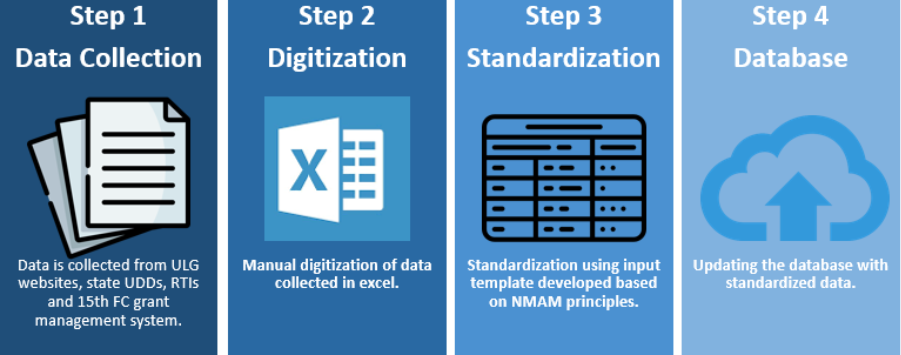
    CityFinance platform’s four-step process streamlines the journey from scattered city ledgers to a unified database, making reliable municipal financial analysis accessible to all stakeholders. Following this process, the data is organized into standardized files containing 77-line items grouped under four heads – income, expenditure, assets, and liabilities – in accordance with National Municipal Accounting Framework established by MoHUA.   
    Through this process, substantial progress has been made: Standardized financial data for at least one year is now available for 89% of India’s ULGs on the CityFinance platform. This standardized format enables multiple analytical lenses: state-wise comparisons, temporal studies, ULG-specific assessments, cross ULG comparisons, population category-based analyses, ULG type-wise evaluations and much more.  

    Looking at the graph above, over 86% of ULGs with populations above 1 million have four years of standardized data from 2019–2023. This focus on larger cities has been intentional—they handle higher volumes of revenue and expenditure and serve a substantial share of India’s urban population, making their data vital for scalable insights and policy design.  

    The above chart highlights multiple barriers to data standardization across ULGs. These errors underscore the need for stronger guidance and technical support to improve data submission standards. 

    The map below reveals that over 10 states have 90% of ULGs data standardized, others, such as Haryana, Meghalaya, and Sikkim, lag significantly behind.  

    The Power of Clean Data: Driving Smarter Urban Governance 

    Standardized municipal finance data is the cornerstone of effective governance. It equips policymakers with reliable fiscal information to design targeted policies, allocate resources effectively and benchmark performance across cities.  

    Standardized data empowers cities to assess their financial health, monitor compliance, and improve service delivery. It enables evidence-based planning, better budgeting, and performance benchmarking across peers.  

    For state and national government officials, standardized municipal finance data provides a reliable basis for monitoring fiscal performance, designing incentive frameworks, and targeting capacity-building efforts. It enables cross-ULG benchmarking, compliance tracking, and policy evaluation at scale.  

    For market participants i.e. credit rating agencies, investors, and financial institutions – standardized data enhances visibility into municipal creditworthiness, enabling risk assessment, debt structuring, and investment in instruments like municipal bonds with greater confidence. 

    Standardized municipal finance data offers researchers and civic organizations a consistent, comparable foundation to analyze urban fiscal trends, governance outcomes, and equity in resource allocation. Civil society groups can use this data to monitor public spending, engage constructively with local governments, and push for reforms grounded in evidence and public interest. 

    Breaking Barriers: Building a Resilient Municipal Finance Data Ecosystem 

    Standardized municipal finance data has begun to reshape urban fiscal governance, enabling smarter policy, better financial management, and more informed understanding.  

    However, this is just the beginning. The next frontier lies in tapping directly into ULG systems to automate data exchange and eliminate manual reporting and duplication. Integrating technologies like APIs and accessing centralized accounting systems can ensure seamless, timely, and accurate data flows. Alongside this, targeted capacity-building for municipal officials and stronger enforcement of reporting standards will be critical to sustaining data quality and expanding coverage. CityFinance is actively working to enable this shift. 

    To dive deep into the standardization process, see: How We Standardize Annual Financial Statements? Explore standardized municipal finance data on CityFinance and see how your city compares.  
  • Open Data, Better Governance: Unlocking Transparency in Municipal Finance Data

    Open Data, Better Governance: Unlocking Transparency in Municipal Finance Data

    Have you ever wondered, during your daily commute to work, why some roads are in such poor condition, or why certain neighbourhoods lack proper footpaths or decent parks? You would have thought about the property taxes you pay and questioned where exactly all that money goes. These are important, everyday concerns for many urban residents, but finding clear answers isn’t always straightforward.  

    The key to these questions lies in one place: your city’s financial data. Municipal finance data tells us how much money our city has, where it comes from, what this money is spent on, whether this money is enough and if the money is reaching the right places.  

    When this data is open and accessible, it does more than just satisfy curiosity of the urban residents. It empowers citizens, strengthens accountability, and enables better decision-making. Transparent financial data builds trust, as citizens see how their contributions are used, and it lays the foundation for cities to plan and deliver services that cater to the people’s needs. But where do we get this data from? 

    Lost in the Ledger: The municipal finance data scenario before reform 

    A few years ago, before the 15th Finance Commission in 2021, uncovering a city’s finances was a complicated and taxing process. To get access to municipal finance data of your city, you would need to file a Right to Information (RTI) request and hope for a timely response. Whatever information provided would be recorded in formats unique to each urban local body, often as poorly scanned documents, making it difficult to interpret or compare. This data would often be inconsistent, incomplete, ambiguous, outdated, and unstructured, further complicating the challenge of understanding municipal finances. 

    Even once you managed to decode these financial statements, a bigger challenge loomed: there were no guarantees about the accuracy or credibility of the data. You were left relying entirely on the word of Urban Local Government, with little means to verify the facts. Comparing your city’s financial performance with another’s, whether for benchmarking, advocacy, or policymaking was nearly impossible.  

    Reform in Action: City Finance  

    Recognizing the deep-rooted challenges in municipal finance data – scattered sources, inaccessible information, and no standardization, the 15th Finance Commission introduced a set of game-changing recommendations aimed squarely at transparency and accountability. These reforms demanded that Urban Local Governments publish audited financial accounts in the public domain in a credible and timely manner.  

    Giving these reforms a practical backbone, the CityFinance platform was adopted and launched by Ministry of Housing and Urban Affairs (MoHUA) in May 2020. This centralized portal became the national conduit for gathering, validating, and publishing municipal finance data for over 4,800 cities. CityFinance bridged these historic gaps, by serving as a single source of truth, automating the sourcing and analysis of financial information from thousands of Urban Local Governments. For the first time now, cities across India can be meaningfully compared, studied, and supported, moving from fragmented ledgers to a living, integrated financial platform.  

    Bits and Bytes of Progress: The status of data now 

    Building on the nationwide reforms of the 15th Finance Commission and the launch of it’s compliance module CityFinance, cities across India are now able to share a wider and more meaningful range of financial documents. Through its dashboards and resource modules, CityFinance now provides access to over 15,000 raw financial statements covering 99% of the ULGs in India.  

    At the heart of modern municipal financial disclosure are audited annual accounts, which ensure transparency, financial integrity, and accountable urban governance. These comprise: 

    • Balance Sheet – presents a city’s assets and liabilities as of the end of the fiscal year. 
    • Income and Expenditure Statement – summarizes financial performance over the year. 
    • Cash Flow Statement – shows the inflows and outflows of cash, revealing how funds are generated and spent. 
    • Auditor’s Report – offers an independent evaluation of the financial statements’ accuracy and reliability. 

    In India, audits of Urban Local Governments are conducted either by external Chartered Accountants or by the State’s Local Fund Audit Department (LFAD). This audit process forms a vital phase in the municipal finance cycle, reinforcing credibility and trust in city-level financial management. Together, these documents provide a reliable picture of whether cities can cover their obligations, the sufficiency of available funds, and how resources are being allocated across service priorities. 

    As a result of 15th Financial Commission’s mandate and CityFinance, cities are now institutionalizing structured processes to ensure that audited financial statements are compiled and published on time marking a significant shift from ad hoc disclosures to routine, systematized financial reporting. This shift not only improves compliance with reform mandates but also strengthens the foundation for long-term fiscal discipline and public accountability. 

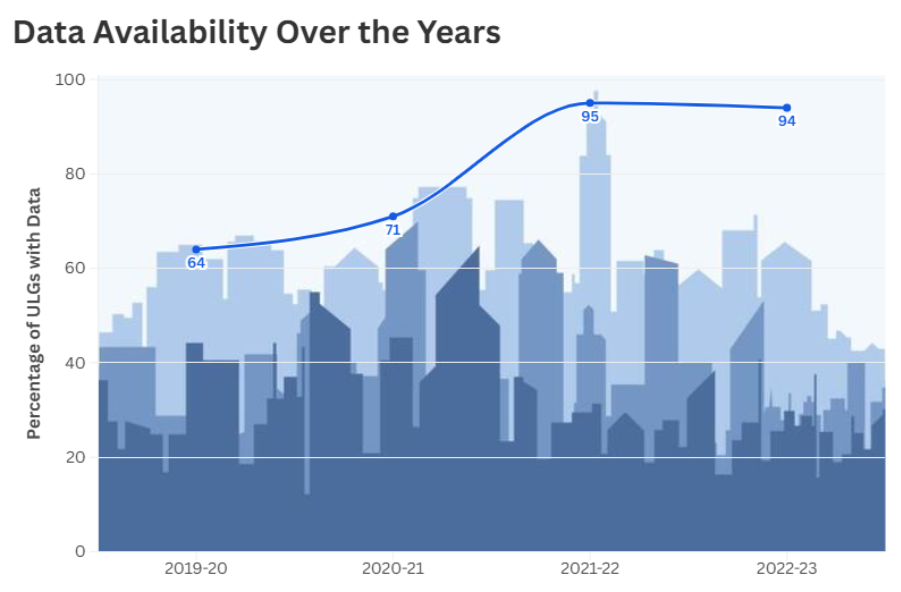
    Looking at the figure, we can see that the percentage of Urban Local Governments submitting financial data has seen a dramatic rise, from just 64% in 2019-20 to 94% in 2022-23, reflecting the impact of the 15th Financial Commission’s reforms and the CityFinance platform. This steady increase in the number of cities submitting their financial statements, shows that more cities than ever are embracing transparency and public accountability in the way they manage their finances. 

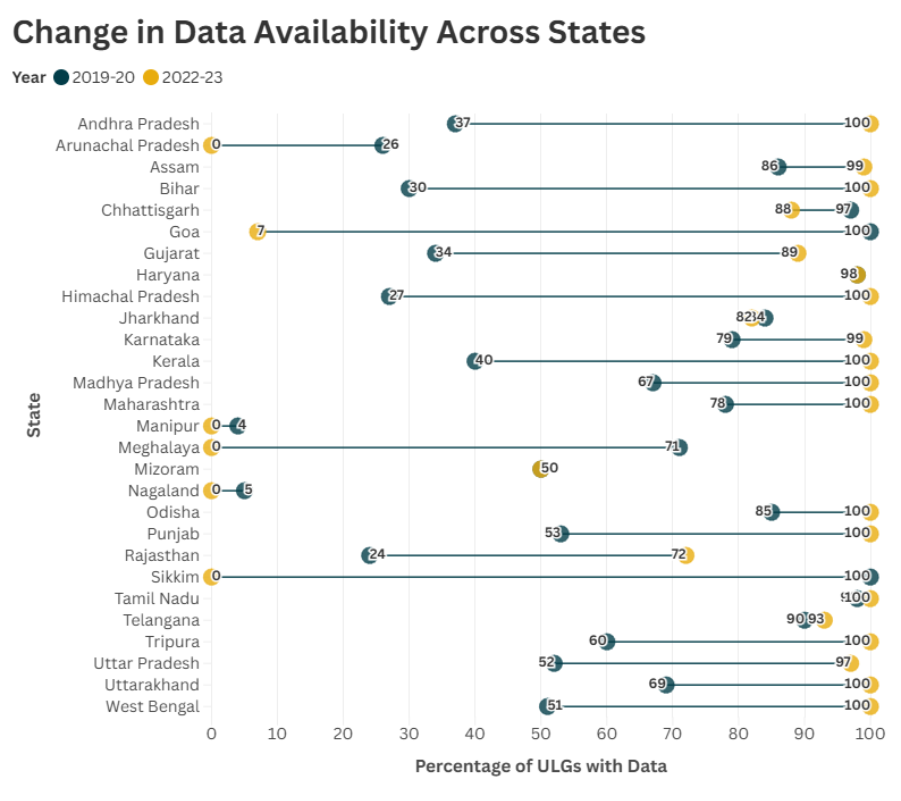
    The above chart highlights the dramatic improvement in municipal data availability across Indian states, with 12 states reaching 100% coverage for Urban Local Governments by 2022-23 compared to much lower levels in 2019-20. The progress underscores the power of the focused financial transparency initiatives in bridging information gaps and enabling robust, evidence-driven urban governance. 

    From Raw Numbers to Real Impact: How Diverse Stakeholders Can Harness Municipal Data 

    Before CityFinance, municipal financial data was locked behind complicated processes, multiple requests, physical visits, and discretionary approvals, with no guarantee of receiving the desired information. Now, datasets of Urban Local Governments are universally available, empowering a diverse and growing set of stakeholders to examine municipal finance data without enduring a taxing process that may not provide the necessary information. However, for the data to truly benefit these stakeholders, it must be provided in accessible and usable formats.   

    For government officials, from municipal commissioners to state administrators, the new availability of reliable financial data is transforming how cities are governed. Improved fiscal reporting makes it possible not only to track spending but also to benchmark performance against other ULGs and across states highlighting strengths and gaps. This data-fuelled transparency fosters peer learning across municipalities. 

    With nearly 95% of Urban Local Governments now submitting financial statements and data available across states, citizens, researchers, and market participants can meaningfully engage with municipal finances. The CityFinance database, covering over 15,600 statements from over 4,800 Urban Local Governments, empowers citizens to track local spending, supports rigorous policy analysis, and enables investors and rating agencies to assess city-level financial health, fostering transparency, innovation, and informed urban investment. 

    In this way, open and actionable data empowers every stakeholder, from city hall to the community to the marketplace, to be more effective, responsive, and engaged in shaping the future of urban India. 

    The Way Forward 

    India’s progress in municipal finance data has unlocked new levels of transparency, empowered a wide range of stakeholders, and driven smarter decisions for urban governance. Yet, the inconsistency in formats and practices across Urban Local Governments still limits comparability, leaving much potential untapped. While audited financial statements offer a retrospective view of actuals, budget data reveals a city’s fiscal intent; how it plans to mobilize and allocate resources across priorities To provide a complete picture of the financial health of our cities, we need to capture and analyse its budget data, covering receipts, expenditures, and key fiscal indicators across years. This work is underway on CityFinance, building the foundation for a more holistic understanding of city finances that goes beyond isolated datasets. 

    The path forward is clear: standardized, unified reporting is crucial for leveraging municipal finance data to its fullest. Better enforcement of common frameworks will enable better benchmarking, more equitable financing, and reliable insights across cities. This next step, harmonizing data standards, will be the focus of future discussions as Indian cities continue their transformation.  

    Stay tuned for a deeper look at how CityFinance’s work on data standardization is helping cities unlock comparable, actionable and reform-ready municipal finance insights.  

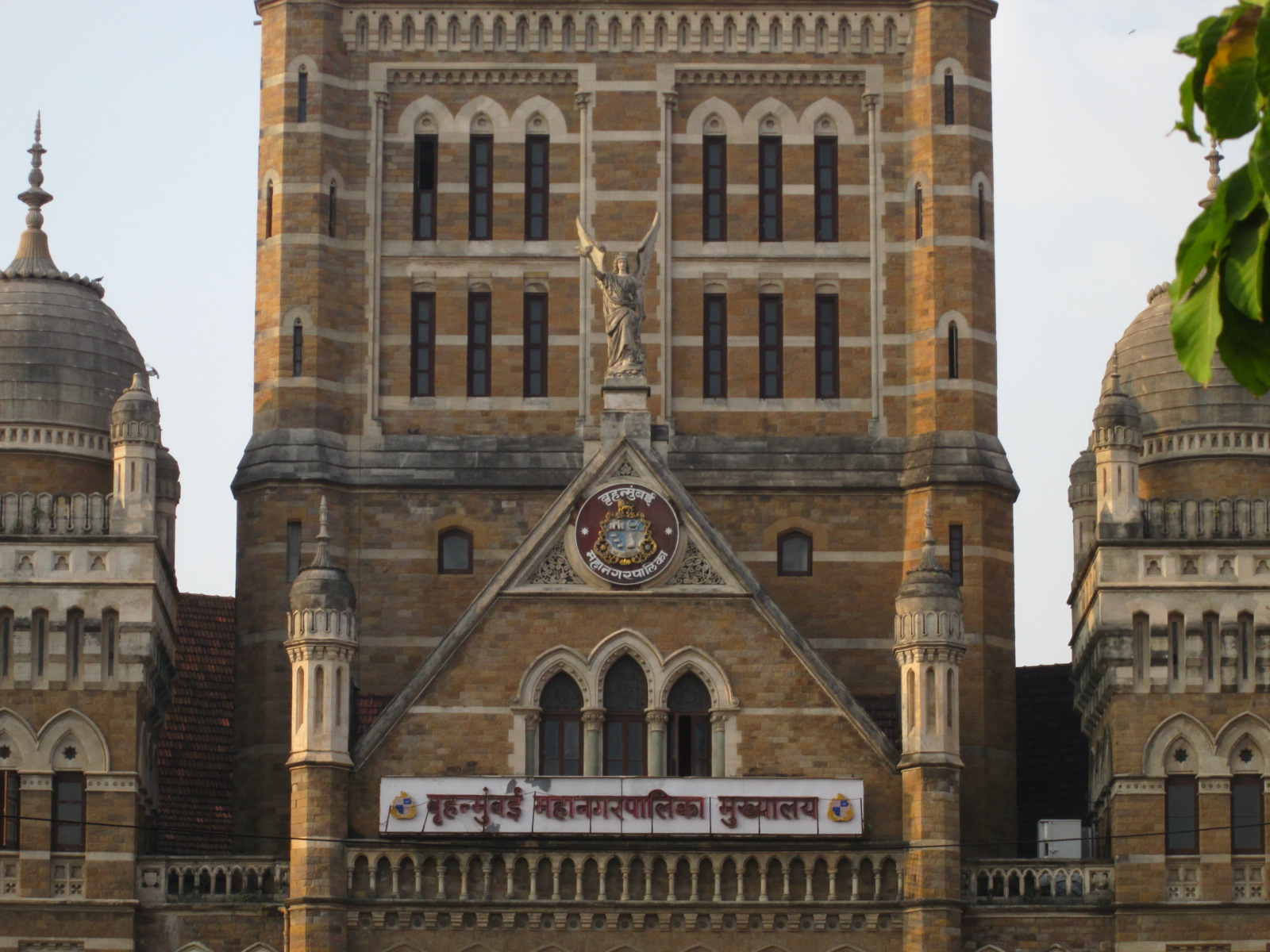
    To explore how you can engage with this data, head on to our Resources section for explainers, best practices and tools designed to make municipal finance accessible and actionable. For a detailed example of data available from Urban Local Governments, explore Brihanmumbai Municipal Corporation’s (Mumbai) municipal finance data on CityFinance.    

    Image credit: Wikimedia Commons